icon-sitemapSitemap | A+ A- Reset | Register/Log-in |

The Global Land Tool Network (GLTN) contributes to the
implementation of pro poor land policies to achieve
secure land rights for all. Read more...

Home

March 19th, 2010

Login
If you do not have an account, please click here to register
Facts
Islamic Land Training Successfully Piloted in Malaysia

islamicdscn5637.jpg

The International Islamic University of Malaysia (IIUM), in cooperation with the Global Land Tool Network (GLTN), Training and Capacity Building Branch (TCBB) of UN-HABITAT and University of East London (UEL) successfully hosted an international pilot training on land and property rights issues in Islamic Contexts.
The training took place from 30 November - 5 December 2009 and attracted 20 participants from 10 countries (Malaysia, Indonesia, Maldives, Vietnam, Cambodia, India, Saudi Arabia, Iraq, Nigeria, and Mauritius). The objectives of the training were to: pilot test the training package for wider dissemination and use; communicate foundational principles of Islamic law and how they relate to land and property rights; develop knowledge, networks and capacity on Islamic approaches to land and property rights; and generate possible action plans and strategies for use in training and workplace settings.

Read more...
 
Putting the Grassroots Mechanism into practice

gltn_grassroots_mechanism_workshop_11_2009_report.jpg

In many countries, laws and policies exist that have the potential to enhance secure access to land for poor women and men. These laws relate to issues such as adequate housing and freedom from eviction, land reform and access to all land-based resources. They relate to cross-cutting issues such as the rights of women and marginalized groups to freedom from discrimination in relation to land and housing. However, very often the implementation of these laws and policies is weak or absent because governments lack the necessary expertise, resources or political will.

Read more...
 
Good land governance is key to realizing gender equality and grassroots participation

web.jpg

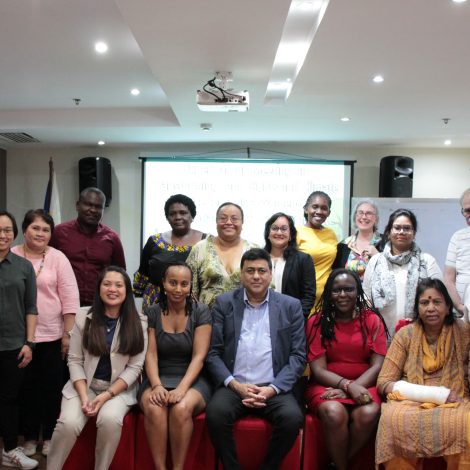
UN-HABITAT and the Global Land Tool Network have concluded a three-day workshop to validate a new training course on improving gender equality and grassroots participation in land governance. The training took place in Naivasha, Kenya from 17-19 November.
The objectives of the training were facilitating the understanding of the concept of land governance, showing the link between good land governance and gender equality as well as genuine grassroots participation and exploring, identifying and unpacking competencies that contribute to good land governance.

Read more...
 
New Era for GLTN Network

At least sixty (60) partner organisations and individuals from grassroots organisations, professional groups, training and research institutions, multilateral and bilateral organisations and civil society groups participated the two-day GLTN Partners' Meeting, 04-05 November 2009, Nairobi, Kenya. At the end, partners' perceive themselves as 'owners' of the Network and the meeting created a significant momentum to push further the GLTN agenda.

Read more...
 
Workshop on “Land and Conflict issues and tools”

land-and-conflict-issues--.jpg

The technical Workshop, held from 14 to17 September 2009 in Nairobi, was organized by UN-HABITAT, GLTN, the Cluster Working Group on Early Recovery (CWGER) and the Protection Cluster HLP Group.  The meeting reviewed progress on the tools that UN-HABITAT is developing with partners on land and conflict, including: Guidelines, Handbook, Check-list and Policy Paper.

The four documents have different target audiences, objectives and lengths as summarized in the table below. The documents are also in different stages of work, the Checklist and Handbook are final drafts and the Guidelines and Policy Paper are undergoing peer-review.  Due to UN-HABITAT involvement in the production of all four, reviewing them in the same Workshop provided an opportunity to harmonize the content and ensure the necessary coherence.

Read more...
 
Call for Proposals For project funding under the Grassroots Mechanism of the GLTN

In many countries laws and policies exist that have the potential to enhance secure access to land for poor women and men. These laws relate to issues such as adequate housing and freedom from eviction, land reform and access to all land-based resources. They relate to cross-cutting issues such as the rights of women and marginalized groups to freedom from discrimination in relation to land and housing. However, very often the implementation of these laws and policies is weak because governments lack the necessary expertise, resources or political will.

But many solutions to these problems are being developed by grassroots organizations and other civil society organizations that work closely with grassroots communities. These grassroots approaches are based upon the mobilization of grassroots groups to fill the gap left by government. But grassroots civil society often faces difficulties in replicating and scaling up these approaches beyond small-scale, local initiatives.

In 2010, GLTN, in partnership with the Hakijamii Trust, Huairou Commision, International Land Coalition and Slum/Shack Dwellers International, will provide support for the scaling up of innovative, participatory approaches to improving the secure access of poor women and men to land.

Read more...
 
Exploring innovative financial instruments for funding affordable housing and urban infrastructure

warsaw_participants.jpg

The International Conference on land and property taxation and financing infrastructural and housing development in urban areas, jointly organized by the Warsaw Office of the United Nations Human Settlements Programme (UN-HABITAT), the Global Land Tool Network (GLTN) and the Ministry of Infrastructure of the Republic of Poland, was successfully concluded last week in Warsaw.

Over 60 participants from around the World and representing various stakeholders in the field attended the event. Seventeen papers exploring policies and instruments for improving equitable, affordable and sustainable land and property taxation, charges and fees, were selected for presentation.

Read more...
 
More News